
Categories
Ministry

And Then Came Wednesday

I have been intentional about not saying anything about last Wednesday’s terrorist attack on the U.S. Capital Building. I am still in a state of numb shock–disbelieving, incredulous (I guess those are synonyms), sad, troubled, and not just a little nauseous. Call them what you will: Traitors, terrorists, bigots, White Supremacists, cult members, murderers. And that’s all the attention this blog will give to them.

US Capitol Building (Photo by S. Nesbitt, 2018)

Our preacher, preaching the Spirit-breathed word this morning, uttered a sentence that I cannot shake out of my head: “And then came Wednesday.”

For many of us, the year came in on a good start, a hopeful start. In fact, my word of the year is “hope.” We knew realistically that 1 January wouldn’t bring a magical end to the pandemic, nor would it prove to be the panacea to fix Washington and the ills in our society. All we knew is that we were leaving 2020 behind. We were leaving behind the continuous crisis condition of the year with its sudden pandemic, shut-downs, monstrously high death toll, and physical separation from people with whom we don’t live. We were leaving behind the grief from all those losses. We were leaving behind the senseless, violent, racially-motivated deaths of innocent Black people at the hands of White racists, both cops and civilians (though mostly cops). We were leaving behind peaceful protests and destructive riots, an extremely contentious election cycle and the false claims of invalidity and fraud by a would-be dictator who can’t accept his loss gracefully. We were seeing news about vaccines and we had hope.

We had hope that we’d see the end of the pandemic. We had hope that the transition of the presidency would bring more help to those people who are suffering so much throughout this pandemic. We had hope that we would never have to see or hear anything else from the current president after 20 January (hope still springs). We had hope that we could coast into 2021, sailing along the last three weeks of the current administration and thinking of new ways to love others.

And then came Wednesday.

Social media blew up with the news. I was teaching, just hitting the peak of our school day after a late start due to a Zoom Bible study. The day had gotten off to a hopeful start. We learned that the state of Georgia had elected two Democratic senators which was enough to flip the Senate to a Democratic majority. Only my cynical fear of two branches of our government being controlled by one party tempered my happiness and hope about new changes. I was also proud that a Black person from the south had been elected to the Senate for the first time in our nation’s history–and a preacher, at that. I thought that was enough history making for the day. Well, that, and Congress finally certifying the electoral college votes which would officially seal Joe Biden’s win. The hope for many of us was that Trump would finally accept his loss, concede and fade off into the end of his administration.

And then came the afternoon. News of a protest by a bunch of sore losing nationalists didn’t warrant any of my attention. Then things turned violent. Innocent lawmakers were being threatened. The political “sacred space” that is our nation’s capitol building had been invaded for the first time since 1814–and it was the British then. People were being hurt. One died. We later found out four more died. And all the while, the president was silent. When he did speak, it was to send the terrorists home with an “I love you.” No kidding.

While some of the domestic terrorists wanted violence, it seems their main agenda was to disrupt the certification of votes. It didn’t work. Congress reconvened later that night and worked until the wee hours of the morning to complete their task. As Wednesday faded into “then Thursday happened,” the men and women of Congress worked while we slept after surviving a frightening, nerve-wracking day.

The cast of Freedom, the gold statue erected on top of the building. It is said that the sun never sets on Freedom. (Photo by S. Nesbitt, 2018)

Sometimes, that day that comes brings a whole new way of seeing life or it marks a day that we will always remember. I was thinking of some of those days.

Then Tuesday came. Tuesday, 11 September 2001. If you were alive on that day, you remember it and can tell people exactly where you were. If you’d traveled by air prior to that, you know how much it changed how we fly.

Then Sunday came. Sunday, 7 December 1941. The bombing of Pearl Harbor. This unprovoked attack got us into World War II.

Then Monday came. Monday, 23 November 2015. I was having a wonderful day with my girls when I slid down in the kitchen and dislocated my knee. That changed all of Advent for us and its festivities.

Then there was that Tuesday in August when our little we-some became a three-some as we welcomed our first daughter into our lives.

Then Friday came. Jesus had warned his disciples multiple times that it was going to happen, but they didn’t really know when, exactly, it’d happen. On that Friday, Jesus died. His disciples were terrified, devastated, heartbroken. Their lives as they knew them had changed.

Then Sunday came. Those same disciples couldn’t believe when the women came back and said that Jesus’ body wasn’t in the tomb anymore. Then they were a whole different kind of shaken up when their teacher who’d they’d see die on Friday was standing right there with them. Before they even had a chance to adjust to Friday’s new normal, Sunday’s newer normal was happening.

Before we had a chance to adjust to the newness of 2021, Wednesday happened. This shook us up. It shook us as a nation. It showed us that the seemingly impenetrable citadel of lawmaking that is our nation’s capitol is just as vulnerable as any other building. It showed us that the despotism and hate-motivated “othering” that we saw plague nations in Europe and Asia in the twentieth century could, in fact, attack us, too. I would like to think that a lot of life-long Republicans were also shaken to their very cores, as the ideals of fair government they held dear and their faith in those ideals ran right into a terrorist attack on the very building that represents those ideals, empowered and encouraged by a Republican president they’d defended and supported. They learned the hard way that they cannot have it both ways: These Republicans cannot have their ideals while supporting the very person trying to destroy them.
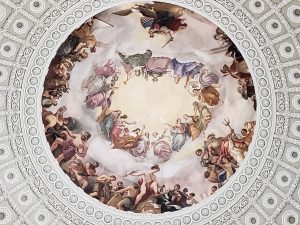
Capitol Rotunda
US Capitol Rotunda (Photo by S. Nesbitt, 2018)

Yes, Wednesday came. It gave us some impressive paragraphs for future history books. It held moments of pride, moments of fear, moments of disgust, moments of sadness, and moments of bravery. I hope history will remember the Senate aides who grabbed the box of ballots and carried it to safety, as well as Capital Police Officer Eugene Goodman, the Black cop who led the terrorists away from the unsealed Senate chamber doors. (Take a moment and appreciate his undeniable courage in being the sole Black man confronting an armed and violent White Supremacist mob.) Wednesday proved to us our vulnerability, and this not only shook Americans, but our allies around the world are scared for us. (I hear the shakiness in an Irish friend’s voice whenever we speak.)

But today is Sunday. Today we wait and hope and pray. We pray for a cease to violence. We pray for justice. We pray that a smooth transition will mark these next ten days until the Biden administration begins. We pray for the leadership that has to work to mend the rift in our nation. It wasn’t a new rift. It didn’t happen in the last four years, but it was a little tear caused and perpetuated by centuries of White fear and white supremacy that the last four years made bigger.

Today we hope. Tomorrow we hope. And every day we hope for something new to begin. Let us be harbingers of that “new.” Let us share our renewed hope in Christ as the one who’ll get us through whatever 2021 brings.


Categories
Ministry Writing

Reflections and Lessons, 2020 edition

As I sit here at the tail end of 2020 and look back at this rather interesting year, I have the opportunity to reflect on the lessons this year has taught me and to see ways in which I’ve certainly changed.

First, my Facebook memories reminded me of how much I was looking forward to putting 2016 behind me. I hope this isn’t going to be a trend every four years!

This year began hopeful. My teen was going into her second semester of dual enrollment and excited about having in-person classes after a semester of doing all online classes. She was busting her hiney and the days started early, but she enjoyed the vibe and energy of being in a college classroom. My tween was going to be wrapping up her life as an elementary school student and looking forward to what lay ahead of her–mission camp just for rising sixth graders, her last spring children’s program at church, and “graduating” from children’s ministry into youth. There’d be a year when both my girls would be in youth group together. (I joked to our youth minister that I’d be praying extra for him, and to let me know if I needed to make a liquor run for him.)

In late February, I finished the first rough draft of my book Finding Peace. Hours at the library while my teen was in class afforded me ample time to write and concentrated time to teach my tween, leaving my afternoons and evenings free to work (when I wasn’t working out in some way). For a writer, these were halcyon, though busy, days. Every day in January and February, I met my writing goals with words to spare.

Then March hit. We had no idea how bad it’d be. The first thing in our lives to fall was school; my teen’s classes went back to all online. It was tough. There were just some classes that needed to be in person for her optimal learning, and her English professor hosed the class over horribly. Church was the next to go. Then soccer season, dance classes, the dance recital, yoga classes, and finally, the highlight of my tween’s year–marine biology camp. We cried together over this loss.

In two months of non-stop losses, living in this crisis mode, trying to understand the pandemic and how to keep ourselves safe, we adapted to new ways of being. Counseling appointments involved long walks and phone sessions. I spent hours a week working out–walking, yoga, weight training–everything I’d been doing before the shutdown. Our hair got long, we adopted the mask life, and we emailed and wrote letters and cards like never before. Suddenly, emails and texts weren’t good enough.

But then in the midst of the losses, gains started showing up. My pastor-friend Cynthia who pastors a Presbyterian church outside of Philly invited me to join in a ladies’ Bible study via Zoom. Over the course of the coming weeks and months, I got the pleasure of getting to know these awesome ladies and learning from them. As the summer blew up with Black Lives Matter peaceful protests and Confederate monuments came crashing down across the south, my rural southern self got to share experiences and perspectives with my new urban/suburban northern friends.

As summer wore on, the refusal of people to abide by simple rules (wear masks and maintain social distance) irritated me. All these people shouting, “My body, my choice!” were overlooking the most basic, simple task of loving others by keeping their germs to themselves. I stayed away from people for the most part, getting out to go grocery shopping (masked and sanitized with handwashing and sanitizing my phone when I got home). We went to the beach where we could enjoy fresh air, sunshine, fun, and organic social distancing.

My teen and I dared to go to the beach for a weekend, staying in a new beachfront hotel. Even though hotel stays are higher risk than we’re accustomed to, we were comfortable with the owner’s Covid response. Most people followed the rules with no problems, and, hey, we were at the beach.

As school started in mid-summer, I expanded my ministry to include my tween’s best friend in our homeschool. I did it mostly to help the girl and her mom. I learned that not everyone is appreciative of what others do for them. I discovered that some people will take advantage of my kindness, and even with a successful homeschool teacher and environment, parent involvement is still mandatory for student success. Now I have a whole new appreciation for what my teacher friends go through.

With any and every ministry, it’s vital to know when to let go. It’s important to recognize when the work is done, when the helper has maxed out her resources, and when it’s time to bless the parishioner and send them on to somewhere that can grab the baton and carry them farther. That time came. My family affirmed this nudging from the Spirit as well as admitting they’re happy they’ll have more of me again.

I learned the importance of self care. I neglected myself for a few months and started feeling the effects of it. The time I’d had in the spring to walk, practice yoga, and tone up disappeared by the fall. By the time my other student went home, it was time to start making dinner.

I learned that I have absolutely no patience or tolerance for narcissistic, self-centered, attention-seeking people. As social distancing and staying at home continued, my social media streams began to annoy me. “Tell me how great I am” posts or endless selfies searching for praise and compliments made me gag. I wondered repeatedly how people can be so narcissistic. It seemed that people needed more and more affirmations from other people when I was thinking, “Let God give you your affirmations, not your social media friends.”

This self-centered behavior went offline, stepping off the screens and manifesting itself in real-life situations. As the pandemic wore on and all the cautionary steps got old and tedious, I heard more and more lame excuses for not wearing masks. One woman told me, “God will protect me from the virus” as her family and she attended church where almost no one masks. Yet, she owns a gun, buckles her little one in his booster seat, and bought a taser for her elementary-aged child “for her protection.” I guess God’s protection only happens within the walls of the church? My teen visited my parents’ church and, after observing the lackadaisical attitudes about mask wearing and safety, declared, “If I were looking for a church or new to Christianity, that would turn me off of the faith entirely.” Christians are supposed to follow the example set by Christ and sacrifice and show love to others, not violate the Torah by testing God.

I learned that I have developed zero tolerance for Christians who aren’t willing to live into Jesus’ command to “Love one another as I have loved you.” Jesus loved us all the way to the cross, but we can’t love each other enough to strap a bit of cotton over our noses and mouths to protect others from our germs.

Maybe it’s my age, but I learned I have zero fucks left to give. Then again, this has been the case for a while. There are people the thought of whom sparks joy for me, and there are people who give me an ugly feeling in my gut. I don’t have time or psychic energy to waste on users and people who are careless with those outside of themselves. I make time for people who have it all together with humility and joy, who can magnify positive energy. I can let go of the former and embrace the latter as we journey together into the New Year. Journey with me as we share love, positivity, and bless each other and those we encounter.

Categories
Uncategorized

The Recipe Pile

It started innocently enough. All I was trying to do was find that one grocery store cookbook that held the recipe for the casserole I wanted to make for dinner. The hutch where we store our cookbooks was a mess, though, making even accessing that section of cookbooks a challenge. So I pulled off the huge stack of loose paper recipes–all those we’ve printed off from emails and websites over the years–and placed them on the table. What a mess! While I had them all off, I decided, Why not punch holes in them and get these bound like I’ve been meaning to do?

First, though, I found the cookbook I wanted. When we were dating and in the early years of our marriage, my husband couldn’t go grocery shopping without bringing one of those home. Sauerbraten noodle casserole with steamed red cabbage on the side… Mmmmm! So good!

Recipe pile
This huge, disorganized stack of recipes had been making our hutch a cluttered disaster

This is what I started with. After about a half-hour or so of sorting and organizing them, I ended up with two 3-ring binders full of recipes, categorized by type of dish with categories in alphabetical order. My tween helped me, so there was some memory-making mixed in with the organization.

As I went through that stack of papers, pulling out what didn’t belong and seeing what I had, so many memories came at me, all tied to recipes and cooking!

Cranberry Orange Sauce–I found this recipe in the early days of our marriage at a website that was a humble alternative to All Recipes but is now a French snack food company’s website. I still make this sauce every year for Thanksgiving dinner and usually have enough to can a couple of small jars for leftovers.

Beef Stew–My dad sent my aunt Susan and me this recipe by email, and one of them made it for a family dinner we had to miss when our firstborn was in the Intensive Care Nursery. Mom brought my husband and me servings of it along with biscuits for dinner one evening while we were at the hospital.

Zucchini au Gratin–This was a side for a fun French meal I made when I was in Div school and our family was just made up of two. That night over dinner, my husband told me he wanted to join me on a long weekend mission trip that was coming up.

Taco Soup (x3)–You know when you lose a recipe, you have to print it off again? Yep, that’s this one. Except, I’ve made it so often, I pretty much have it memorized. It’s a family favorite. Paula Deen’s recipe. Look it up; you won’t be sorry. But then there was also the one from the now-French-snack-foods site and my Aunt Linda’s.

Butternut Harvest Soup–Also times 3. But I found the one that’s got my own custom seasoning tweaks written on the back. Super-win!!!

Gingerbread–Not cookies (though that recipe was in the stack, too). No, I’m talking about warm, spicy, fragrant, soft gingerbread, maybe with a lemon glaze on top. I first tasted this on a field trip to Duke Homestead when my firstborn was in daycare. Now I make it to go in an adorable Nordicware gingerbread boy and -girl loaf pan Susan sent me. Hmmm… Now I want to make gingerbread.

In this day of modern technology, recipe websites galore, and the handy-dandy online recipe storage tool known as Pinterest that we can access from any device, paper recipes are almost a thing of the past. But when’s the last time you sat down with your child or spouse with a recipe printed on paper and said, “I made this when” or “This recipe came from your grandma, and I remember that time…”? Having a much neater Mimi hutch (the hutch was handed down to us from my husband’s grandma) is valuable, but the stories of the recipes on it are treasures beyond measure.

Categories
Uncategorized

What’s in your Twenty-Four?

Twenty-four hours. One thousand, four hundred, forty minutes. That is how much time each of us gets each and every day to make things happen. Multiply that times seven to get one hundred sixty-eight — 168 — hours in a week. So why don’t we all have enough time?

I heard someone say today that someone else doesn’t have time to do something that’s important. I just looked at her and asked, “Why not? She has the same twenty-four hours in the day as the rest of us.” Once one of my students came to me with the excuse of “I didn’t have time to get my work done.” I asked her if she’d had time to play with a friend, to which she answered in the affirmative. I told her, “If you had time to play, you had time to get your work done.”


Sometimes, there just doesn’t seem to be enough hours in the day. I get it. I go through those days, too. They usually happen right around the time of big events, so they’re not everyday occurrences. Some days, the craziness and crammed up days are scheduled. When I wake up, I know that’s ahead of me. Nothing else will fit in those days, and as it is, 1:00 a.m. sees me still working, still pushing through the last little bit of work before I crash in exhausted slumber.

Then there are the other days. You know the ones I mean. You get up and get things done. At the end of the day, you have an extra thirty minutes or even an hour or two to focus on that something else that may be important. In my days, my work day often starts when our school day ends, so I could conceivably be “on” as mom and teacher for eleven hours then turn around and snag an extra hour or two of work before bed. When it comes to that time I have to be productive, that time I must use and finesse for the sake of efficiency, I have a choice: I can buckle down and get my work done, or I can piddle away the time chatting with friends, cruising social media, or playing games.

Then there are weekends. It is quite common for me to use Saturdays as make-up days. Sundays, too, if I absolutely must, but I try to keep sabbath on Sundays. When I have important priorities, like taking courses, working, or catching up on things for the house, then those take precedence over every thing else. When that writing course or that online class on publishing will help me advance my career and ultimately benefit my family as a result, then forget fun! I don’t mind being anhedonic for the short-term when there is so much delight on the other side long-term. After all, I only have 168 days a week to get that week’s tasks done, so I better prioritize my time because once it’s gone, it’s gone. There’s no getting it back.

This is the opportunity cost of time. It’s just like with money. If you have a task that needs to get done, and you need to spend five hours a week completing it, then you have budgeted that five hours for that task. If you then burn part or all of that time in talking to friends, playing games, or running all over town for fun, then you don’t get those five hours back. They’re gone. *poof* Disappeared.

I no longer hear “I don’t have time” from myself or anyone else. We have time. We just have to decide how we’re going to invest our time. Often, if we have less fun with our time now, we’ll have the time and money to have more fun with our time later. It’s a simple concept: Work first, play later.

Categories
Ministry

How Pro-Life Are You?

The question has come up for many people lately: How can Christians, even evangelical Christians, support a president who has shamelessly broken most of the commandments, brags about having broken them, and continues to violate them without remorse, regrets, or repentance? How can Christians support a president who falls far from the Jesus mandate to “Love one another”? It’s been my observation and experience that these folks are single-issue voters: Abortion. It doesn’t matter how reprehensible or abhorrent a candidate speaks or behaves; if she or he promises to make abortion illegal, then these evangelical Christians will vote for them.

But what does it mean to be pro-life? Does it just mean to be anti-abortion? A true pro-life ethic is pro-life from womb to tomb. Let’s take a look at what that means.

  • Pro-life means valuing the life of the fetus. It honors this life by wanting free or affordable prenatal care for the pregnant mother.
  • Pro-life means valuing the lives of children. It wants every child to have enough nourishing food and clean water to thrive in life and school.
  • Pro-life means valuing the health of all people. It believes that free or affordable healthcare is crucial to ensuring a healthier population. (Recent studies have shown that access to affordable birth control methods have led to a decrease in unwanted pregnancies, which, of course, has led to a decrease in abortions.)
  • Pro-life means valuing the safety and well-being of non-Americans, too. It abhors the idea of families of any skin color being ripped apart and innocent children being caged like animals.
  • Pro-life means valuing the nutrition needs of all people. It seeks to eliminate food deserts–areas in urban centers where healthy, affordable food is unavailable. It also seeks an equitable distribution of food resources so that no person should go hungry.
  • Pro-life means valuing the planet that sustains us. It acknowledges climate change and humanity’s sin in not exercising the stewardship over creation that God entrusted to us. It wants to be proactive in reversing the damage we have done to the earth so that future generations have a planet that will sustain and nourish their lives.
  • Pro-life means valuing the dignity of all humans. It recognizes the humanity we each possess as beings made in the image of God. It allows people to choose not to burden their families with exhaustive life-saving measures when death is imminent.
  • Pro-life means valuing the mental health and safety of all people. It seeks to restore mental and emotional wholeness to people with fractured psyches before they act in violent ways against innocent people.

If any one of those points bothers or angers you, then you would do well to reexamine what it means to be “pro-life.” A true, holy, God-honoring pro-life ethic cherishes all life from womb to tomb. It not only seeks to eliminate the need for abortions, but it also cares about people after they are born, ensuring they have adequate housing, food, and healthcare. This holy pro-life ethic also determines to take steps to reverse or stop climate change; being good stewards of the earth God gave us; and making a healthy, life-sustaining home for all of God’s creation, be it plant, animal, or human.

If you cannot ascribe to each of these items and recognize that all of these (and probably several I didn’t think of) are part of a pro-life ethic, then you need to change your tune.

You’re not pro-life; you’re just pro-fetus.

Categories
Mental Health

A Time to Regress

My teen is taking Intro to Psychology this summer, and probably the most worthless Psych course conceivable. Since the course failed to cover Freud’s theories in depth, I dusted off my beloved Psychology degree and taught her this myself. No study of Freud would be complete without covering his ego defenses (aka, defense mechanisms), especially since it’s so easy to see these ego defenses manifest themselves in our lives and the lives of others.

According to Freud, ego defenses are necessary to the survival of our psyches, but if they are overused, they lead to dysfunction, even neuroses (to use a mid-nineteenth century psychology term). Denial, for example, gives our brains a moment to catch up with bad or distressing news. Think about it: How often does someone cry out, “No!” when they hear bad news? You can see compensation in the guy with the huge pick-up truck with the loud muffler. My daughters are masters of displacement. When I get on one of them about not doing her chores or studies, she then picks a fight with her sister.

Today, though, I want to talk about regression. This is the ego defense in which the person goes back to an earlier stage of development. Maybe the person curls up in the corner and sucks their thumb when they haven’t thumb-sucked in decades. Another example is when older children begin to bed-wet after they’ve been abused. Or a teenager curls up with her favorite stuffed animal at the end of a hard day.

I have found myself using a little regression today. We’re in the midst of a major clean, and I was working on the floor in one little section of the dinette. I had knelt on a chair and was bending over to pick stuff up. About the best way to envision it would be like a melting child’s pose. (Even yoga allows space to regress in practice.) I was tired, and it felt good. Nevermind that adults are supposed to sit in chairs properly, and most assuredly without their rumps on level with the top of the table. For those moments I was melting over the chair, I forgot my stress, forgot my ginormous to-do list, forgot everything. I was in that moment in a seat in a silly way, just as I used to do when I was a kid. And it felt good.

I got up. I cleaned and hefted. I worked and parented. In short, I adulted. For those short moments, though, I chilled as a child, enjoying the utter relaxation of my position in the chair. For a few moments, I regressed just long enough to charge myself back up for being me.

Categories
Ministry

It’s Okay to Groan

For we know that if the earthly tent we live in is destroyed, we have a building from God, an eternal house in heaven, not built by human hands. Meanwhile we groan, longing to be clothed instead with our heavenly dwelling, because when we are clothed, we will not be found naked. For while we are in this tent, we groan and are burdened, because we do not wish to be unclothed but to be clothed instead with our heavenly dwelling, so that what is mortal may be swallowed up by life. Now the one who has fashioned us for this very purpose is God, who has given us the Spirit as a deposit, guaranteeing what is to come. (2 Corinthians 5:1-5, NIV)

We groan. We are groaning. We have been groaning for months now. We groan over the illness of loved ones. We groan over not being able to see beloved people. We groan about perceived rights being taken away from us. We have become a groaning people, and in many ways, we certainly have the right and justification to be this way.

My friend Cynthia led a Bible study this morning in which we looked at this whole chapter, but I was fixated on “Meanwhile, we groan.” That was a fresh, liberating idea. Groaning hardly seems like something that should be fresh or liberating. We usually groan with oppression or illness, both of which keep our physical bodies enslaved, either to another person or to malignant organisms. Here in this passage, Paul is talking about groaning because we are in these physical bodies when we long to be clothed with our promised heavenly dwelling. For many people, that is their normal groaning as they long to break free from their physical burdens and struggles.

Yet, Paul’s acknowledgement that we groan is what’s liberating to me. In my year of chaplain residency, I probably heard about a dozen times, “I don’t understand why he’s sick. We read our Bibles daily. We go to church three times a week. We pray every day (not just blessing meals). Why is God doing this to us?” In the midst of sickness, these people–usually women–had never been told, “It’s okay to groan.”

You see, the litany above reads like a check list.

  • Church three times a week. Check.
  • Read Bible daily. Check.
  • Pray every day. Check.
  • Get unlimited blessings from God. Ch–. Hey! Wait a minute! Something’s not working for us here.

The pain for these lovely people is that they had not been properly prepared for the reality of living in a fallen creation. They had been exposed to a variation of the Health, Wealth, Prosperity heresy, either by watching its proponents like Joel Osteen on television or coming out of the pulpit on Sundays. (Sidebar: I’m guessing your average pulpit preacher who ascribes to this heresy believes it’ll make him as wealthy as Osteen, so they spread the heresy.) Unfortunately, despite their checking off all the prescribed tasks, these parishioners were facing a decline in health. How can this be? They did everything right. Why is this beloved spouse or parent suffering and sick?

Somewhere along the way, they were taught they never have to suffer, so they’d never be in a position to groan when the truth is, groaning is a perfectly acceptable response to pain and suffering. The apostle Paul tells us that it is okay to do that. We can live into our humanity and groan over our sufferings and the sufferings of those we love. We can groan through our faith, knowing that God hears the groanings of our hearts, minds, and souls and responds to them through comfort and compassion. We can groan because we are human and sometimes words fail us. Is is okay to groan.

Categories
Mental Health

Embracing the Lizard Within

Week before last, my quite girly younger daughter had the opportunity to pet-sit for her best friend’s dad’s pets, which included two toads, a bunch of fish and snails, a bearded dragon, and the dubia roaches that make up the (I’m guessing) tastiest part of the lizard’s diet. The bearded dragon’s name is Spike, and he’s kind of cute–for a reptile. Spike lives in a decent-sized plywood box with heat lamps, rocks, fake logs, fake greenery, his food and water bowls, and even a hammock. He gets everything he needs.

In the wild, Spike’s little lizard brain would hone in on only one thing: Survival. He would eat, drink, have sex, and go wherever he needed to to regulate his body temperature. He lives in the here-and-now. He doesn’t fret over if he’s going to get fed or when. He doesn’t worry about if he’s going to roast under the lamps. He exists in each and every moment as it’s happening.

We humans have lizard brains, too. This is the brainstem, that part of the brain that serves only to keep us alive. It keeps our hearts beating, our lungs functioning, and our temperatures in check. It helps us to survive. This part of our brains doesn’t worry about what’s going to happen tomorrow or next week. It’s not, for example, stressing out about birthday parties or what its daughter’s community college is going to do about classes in the fall. It doesn’t stay up fretting over the snide barbs that supposed friend shot at us. It has no thought about bills or doctor’s appointments, or anything that jumbles up the other, bigger parts of our brains.

My challenge to you is to embrace your lizard brain. Let it have the run of your head for a few minutes. No, don’t take this to mean you have to propagate the entire species by yourself. But be like the lizard. The lizard only concerns itself with what is happening in this very moment. It only responds to threats that are right here in front of it right now. So, if there’s nothing trying to kill you or eat you, then there is nothing to respond to. That threat or that worry that wants to plague your mind doesn’t actually exist, so it doesn’t deserve your attention.

This looks like pushing the pause button on the other two parts of the triune brain. This looks like letting those two parts of the brain rest while the primitive lizard brain, which never rests, runs the show for a bit by itself. So, for a few minutes–two or three or five, at least–close your eyes and be in the moment. Focus on what you’re feeling against your skin. Think of what you’re smelling, what you can hear. Focus on your breathing as the air goes in and out of your body. Taking this time will reduce your anxiety and ease your stress, lowering your heart rate and your blood pressure. In this time of Covid-stress, we all could use some of that!

Categories
Ministry

Oh the Irony! Wanting the Healing Without the Humility

I love irony, and I delight in seeing ironic situations play out. Better yet is when those who are engaging in the ironic behavior don’t see what they’re doing.

I happened to be driving down a 2-lane street one block off of the downtown grid in our sleepy little town. This was completely unintentional. My route took me past one of the Baptist churches in our town, a notoriously conservative congregation. In front of their church was their regular, permanent church sign with 2 Chronicles 7:14 which reads, “If my people, who are called by my name, will humble themselves and pray and seek my face and turn from their wicked ways, then I will hear from heaven, and I will forgive their sin and will heal their land.” Another, newer, temporary sign announced “Worship Sunday at 10:30 in parking lot or sanctuary.”

I think I get where they were going with this Bible verse. Our land is in need of healing from the coronavirus and political divisions. It’s in need of healing from corrupt, violent cops and paid rioters and looters who are trying to foment more division. We can all agree that our land needs healing to various degrees, though we may not all agree on a diagnosis.

This verse is powerful, but it doesn’t just quote God as saying, “I will forgive their sin and heal their land.” No. There’s something we have to do first. The very first thing we have to do is humble ourselves.

The opposite of humility is pride. It’s pride that puts ourselves first and our wants first.

Pride refuses to wear a mask because it’s “inconvenient,” “a violation of my rights,” or “a violation of my freedoms as an American.” Humility wears a mask to protect other people from viruses the person may be unknowingly carrying.

Pride insists that we have to be in church together. Humility practices patience to keep vulnerable members of the congregation healthy.

Pride demands its way when it comes to having church services. Humility understands that we are the church and can do church outside the walls.

Pride puts itself first while humility puts others first.

The chronicler straight-up tells us that we have to put other people first. That comes before praying. It comes before seeking God. It comes before repenting. Humbling ourselves–putting our pridefulness aside–is the first step to God doing God’s part. (I love this verse, because it’s two sermons in one–one 4-pointer, one 3-pointer. Good for two consecutive Sundays.)

If we want God to heal our land, we have got to humble ourselves enough to put others first. We have to wear our masks to prevent spreading the virus to other people out of our God-called love for them. We have to keep at least six feet away from people if we’re unmasked. We have to squelch our insistence on having our own way when it comes to church. We have the right to be Christians, to tune into online worship (even at other churches if we want!), we have the right to read our Bibles, we have the right to be the church. We do not have the right to gather for worship when Christian charity deems it unsafe to do so. Insisting on worshiping in unsafe times is prideful. Practicing self-control is humble.

Know what else is humble? Following the biblical command to follow laws and rules we may not agree with. Whether we are “rendering to Caesar what is Caesar’s” (aka, paying taxes) or following the law of the land, the Bible is explicit on what we are to do. While I have no problem with our governor’s order to wear a mask, I realize others don’t feel the same. However, those same people who refuse to wear masks will tell you that they love the Bible, love God, and love others. They may even tell you they live by the Word, obeying every word it says. I get it. But it’s not about us now. It’s about others, the people we’re told to love.


Categories
Books Ministry

More about the Voices Project

To submit your own contribution, email it to Voices@SaraDNesbitt.com. Please feel free to ask any questions you may have in the comments.

Enjoy this blog? Please spread the word.

RSS
Follow by Email
LinkedIn
Share
INSTAGRAM
Copy link
URL has been copied successfully!