Years ago I was training to be a chaplain. That’s a pastor who serves in secular settings, especially hospitals, the military, prisons, and hospice agencies. It’s a special kind of ministry, working with people in the midst of some life crisis, and the focus is less on a ministry of word (like you see with pulpit pastors) and more on a ministry of presence. We’re there. We’re present. Most of the time we listen. Sometimes we talk. Sometimes we offer a shoulder. Sometimes we share Coke and pork rinds. It’s a more fluid ministry, one that allows chaplains to live into their own creativity and outside-the-boxness.
I was a resident, and my supervisor and I got along grudgingly. I’d like to say he was invested in my improvement, but it so often felt like all he was invested in was breaking me as a chaplain, finding fault in everything I did so I’d quit and give up the calling. I’m made of sterner stuff than that, though. One of his constant gripes about me was that I “wasn’t in touch with the richness of my emotional life.”
I was telling my therapist about this, the therapist who’s seen me crying and yelling, cussing and laughing. I told Jen about that supervisor telling me I wasn’t in touch with the richness of my emotional life, and she said, “What the hell does that even mean?”
It comes down to trust. Neither that supervisor nor that group felt like a safe place to share my emotions. It’s not that I didn’t have them. I also expressed them openly and passionately–just not there. I let my feelings loose at home with my husband.
There were also other trust issues. I had been taught from an early age that expressing my emotions publicly was “making a scene,” and this was vehemently discouraged. Even when my grandma died, I was shushed in the hospital corridor so as not to disturb other patients or make a scene. So expressing raw, naked emotions in front of people I didn’t really know or trust was simply not going to happen.
I’m happy to say to that former supervisor, “Up yours!” as I live fully into the richness of my emotional life. I’ve poured emotion out in my counseling journey. I used my feelings about having anxiety and how I’m managing it as the basis for my first book. And now, the emotion is coming out, sometimes in trickles, sometimes in floods, as I write about what it was like raising my firstborn and the pain she caused us.
So what does “living into the richness of my emotional life” look like? It looks like having the bandwidth to deal with emotions. It looks like daring to say the hard parts out loud. It feels good and liberating and relieving.
Today is 22 February 2024. On 24 February 2020, I finished the first draft of Finding Peace: Devotionals for Christians With Anxiety. What followed was a maelstrom of “Oh, hell, where is my therapist when I need him?” and editing this book to within an inch of its life–and that was before sending it off to a professional editor. Then it loitered in my computer for a few years, trapped by its creator’s fear that it’d be rejected. Until a certain daughter of mine broadcast to friends and family alike that I’d written a book.
Today my print copy came, and I’m so excited! I finally get to say, “Buy my book.” My hope is to make enough money off this book to launch the next one, and then eventually to be able to help other writers publish their books. The goal is not only my own success as a writer, but that of others, as well.
Click the link to get your copy. And thank you.
FINDING PEACE: Devotionals for Christians With Anxiety
I am usually the last person you’ll hear talk about “submitting” to anything or anyone, but sometimes “submit” brings with it the greatest feeling of freedom. In the words of Luvvie Ajiyi Jones, it’s like going from swimming to floating.
As I type this, I’m floating. I’m in warm Caribbean waters, floating on my back, letting the gentle waves bouy me. Water laps into my ears, drowning out all sounds. The sun is warm on my face and chest, and every part of me is relaxing on the water, trusting it to hold me up. In my fantasies, of course. In reality, I’m sitting in the living room on a grey, chilly winter day.
You see, today was a “submit” day. Today was the day I chose to do our taxes for the year. My goal used to be to have them done before the beginning of soccer season just because taxes take a number of hours to do, and I didn’t want to start late or have to take a break from them once I got started. It quickly gets addicting having the relief of taxes done and the refund sitting in the account before the end of February. I was going to work on them last weekend but got invited out for coffee, and that was a more important thing in my world.
Today I clicked “submit” or, rather, “file federal return.” Our taxes are done. The IRS has accepted them, and I don’t have to worry about them now. Having that burden off my shoulders was tremendous! And even though I only usually promote my personal stuff, let me just say that Tax Act made filing so ridiculously easy!
On Tuesday I clicked “submit” on another big project–my book. It’s gone through a bajillion tweaks, especially the cover. The last copy was the best, and I ordered a print copy to see how the beautiful eproof will translate to paper binding. Hopefully, that’ll arrive late next week. That was something else that I’m happily getting off my shoulders so I can turn my focus to my next book.
Ahhh, yes. The next book. A work of heart, soul, and psyche. This one is brutal to write. It started with a really good therapy session, a session that left me feeling like my psyche had gone ten rounds with Mohammed Ali and also that it’d taken 240 volts. It felt bruised, battered, worn out, and energized all at once. That’s a damn good session, right there! I texted that to my male bestie. I didn’t want to blow up his phone with texts about it so I just texted that I’d fill him in tomorrow. (It was evening when we were having this convo.) I was going to email it, but then I thought, I want to be able to build on this as necessary without fear of accidentally clicking “send” prematurely. So I put everything into a .doc. By the time I was done, it was 3 1/2 pages, single-spaced. (To give you an idea, a solid 20-minute sermon is four pages.) I emailed it to him. The following morning I started editing. Not long after that, I put it into my bookwriting app. I’ll share more details about this book in a future post.
In beginning this book, I submitted to something bigger and more powerful than I alone–the power of story and its ability to connect us to others who share our pain.
It was 2007 or 2008, and I was sitting across the desk from one of the OB/GYNs in the practice I was going to. I’d just had my annual pelvic exam, but really good gynos check out everything, probably knowing that women aren’t great about scheduling annual physicals. All was well “down there,” but the weight was another matter. The doctor said, “Your BMI is way too high [probably around 33 or 34 at the time]. You need to get down to 135 pounds.”
I looked at him and said, “That seems unhealthily skinny to me. I’d feel more comfortable at 150.”
Fast forward eight years to when I started trying to lose weight by tracking my food intake and walking–a lot. One of my goals at the time was to be able–physically fit enough–to be able to do mission work if called. I wanted my body in good enough shape to handle the possible rigors of being the hands and feet of Jesus. Then fast-forward to now. Today I hit 150 pounds, and I feel like I’ve got another ten to go.
I haven’t been called to the foreign mission field. I haven’t gone to Costa Rica or Haiti to help build homes from earthquake rubble or repair a church. I haven’t even been called to do local mission work through a non-profit or with one of a church’s ministry partners. But I have been called to serve.
About two months ago, my maternal aunt died, and my mom is the executor of the estate. She’s under a tight deadline to get everything done, and it’s a lot for her to handle, even with Dad’s help. Last week I told her I’d come up to help. I sat on the floor for about half an hour inventorying my aunt’s extensive CD collection. I climbed up and down off a step-stool cleaning out her kitchen cabinets. I hauled boxes out. I used that same step-stool to bring items in my aunt’s closet down to lower shelves to make it easier for my parents to get to them when they were ready. It was three solid hours of a great deal of movement. Thing is, I wouldn’t have been able to do these things nearly so easily had I not dropped so much extra weight.
And it’s not just a matter of dropping weight. I’ve been practicing yoga since spring 2018 which has given me the flexibility and balance to sit on the floor (and get up) and climb on step-stool. My weekly weight training–much as I hate doing it–enabled me to have the upper body strength to haul boxes loaded with canned goods. The mission work that I envisioned being in foreign and exotic places took place two hours away in a lovely house in autumn. And it was good.
Sometimes we miss seeing where God is putting us because it’s not where we were expecting to go. Mission work, though, is simply being the hands and feet of Jesus, or sometimes the ears and shoulders of Jesus as we move about in our day-to-day.
I unplugged this past weekend, for the most part. My phone was on “do not disturb” all weekend with settings that would only allow my husband and my younger daughter’s best friend to get up with us. I did this for our annual mother-daughter beach weekend, and I frankly don’t want it to end. The lack of notifications, that is. Well, the weekend, too, but we had to get back to real life eventually. And husband/dad. And cats.
Glorious shades of blue. Ocean Isle Pier.
Hurricane Lee churned across the Atlantic, growing ever closer to the Caribbean and maybe us without any observation or tracking by me.
Politics went on, and we didn’t care. Politicians flung manufactured outrage and deception, and we didn’t hear it or even know about it.
People posted in our volunteer community, and I didn’t read the posts right then, and that’s okay. They’re still there waiting for us.
Vacation messages went out in response to emails, and I deactivated my Gmail app. I didn’t want to be bothered, didn’t want anyone to intrude on this time. I also didn’t want to be tempted to check it. And truth, I hated having to get into my email because, again, I liked the digital solitude.
I put a vacation message on my voicemail so not even voicemail notifications would try to capture my attention.
TikTokers still recorded and posted messages that I’m sure they feel are important, and they passed me by. If I find I care enough to go back and watch them, I will. But likely I won’t.
For the weekend I didn’t think about or worry about church stuff. I didn’t worry about the small Bible study group that people think I’m going to take over when I have no interest in doing so (much as I love them). The topic didn’t even come up between Hannah and me about future youth activities. I didn’t think about the usual faith-based things on my mind, like my reconstruction, podcasts, how to love and serve in community in ways we’d find fulfilling, or even which community in which to do those things.
This freed me up to experience the spiritual and the holy. The entire weekend was marvelous, but Saturday night Hannah and I took a walk which metamorphosized the weekend into the realm of the spiritual in the midst of the holy.
We’d had dinner and walked to get ice cream. We had planned to watch a movie after we got back to the room. But we started walking along the beach. As we walked, we held hands. She still likes to do that with me. And we talked–about pretty much everything. Eventually talk came to a memorial service we had coming up in the next week. We talked about the departed family member, and we grieved. We didn’t so much grieve the loss of the relative but the loss of relationship for one of us, and that there never really was one for the other.
Under God’s holy sepulcher where whispy clouds played hide-and-seek with diamond-brilliant stars across a black velvet sky, I shared a dream I’d had about our dead aunt right before our trip. My daughter said, “I don’t think I need to help you interpret that one.” Never mind who taught her various psychological methods of dream interpretation. The dream felt spiritual, like I was saying in my mind and spirit what I didn’t get a chance to say before she died and having her hear me, as well.
The walk went and went and went. We stepped on cold slimy things that we hoped were seaweed or palm fronds drenched from the day’s rains. Cool water occasionally kissed our feet, dampening the hem of my pants. And still we held hands and talked. We logged about three miles total, walking on the beach.
Last week I’d sensed that this weekend would be her and my best weekend to date, and I was right. No longer is the specter of the pain her older sister inflicted on my heart three years ago when I took her to the beach haunting me. I was surprised on Friday to discover that pain, that heart-hurt, is gone, leaving me feeling completely liberated. And I lived fully into that liberation all weekend long.
There are no coincidences of timing. I’d hoped to complete one more bonus episode of Ministry in the Grey before starting on the second season. Hannah was slated to co-host with me, and things were looking good. Unfortunately, technical issues prevented our launching that episode when we hoped so while she was away I went ahead and moved on to Season 2.
Several people have wondered why I didn’t touch on homosexuality in Season 1 of Untouchables. After all, I make no secrets about my feelings on this topic. I wanted to give a gentle word, an affirming Jesus-word. Only problem is, Jesus had no words to say specifically about those in the LGBTQ+ community. He does have actions, though, and there’s a little saying about actions speaking louder than words. So I invite you to take a listen. Engage with this episode. Imagine. Allow your creative brain to envision Jesus and you experiencing each other and how that feels. I posed this to our small Bible study group, and words like “nice,” “good,” “warm and fuzzy” floated around. My goal is to help others experience Jesus the risen Christ in the same way.
It’s been a long time, hasn’t it? Much has gone on in the many months since my last post including the passing of the worst summer of our lives to date. It’s fall, almost winter. Advent is here! The tree is trimmed; the yard is decorated with many glowing, twinkling lights; and yours truly has started podcasting.
Today’s episode came to me during the night. Today my younger daughter and I put up the Nativity scene, and this week’s episode explains how this cherished, traditional bit of our family’s Christmas decorations represents the good news of hope for all people everywhere.
Take a listen here:
You can also catch the Ministering Wildly podcast on Spotify, Google Podcasts, Amazon Music, and iHeart Radio.
With the Russian invasion of Ukraine comes the faces of war. You’ve seen them, I’m sure. They are women. They are children. They are fathers devastated by the loss of their families. They are even Russian soldiers who are too human to want to follow a homicidal maniac’s orders to kill innocents.
War always brings its innocents. Eighteen-year-old boys who are ripped from home by conscription and handed a gun after six weeks of training are sent to kill other eighteen-year-old boys who are pretty much just like them, separated only by language, culture, and nationality. We’ve seen the slaughter of women, children, and the elderly. We have seen remote attacks on hospitals and apartment communities. Russians have fired upon caravans of Ukrainians heading out of the country in search of refuge in neighboring countries. Remarkable is that I’ve yet to hear the term “collateral damage.” These innocents aren’t unfortunate victims of repercussions after a missile attack. They themselves are the targets.
This war is showing the strength of women. Yes, we’ve seen the heartbreaking images of suitcases, the only remains of a man’s family. We’ve seen the pictures of a pregnant woman, a survivor, however briefly, of a missile attack on a maternity hospital. (Her baby and she died the following day.)
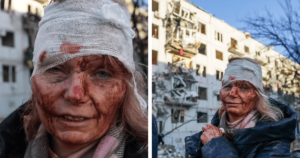
Then there’s Olena Kurilo, a 52-year-old kindergarten teacher. Early in the war, the apartment complex where she lived with her husband was struck by a missile. She was inside their apartment, and the windows were all blown out, glass shrapnel flying everywhere. She survived with a damaged eye but otherwise superficial wounds. Her husband was saved by a fortuitous flat tire. They now live outside of the city; their adult daughter is still living in a shelter.
Olena Kurilo after the missile blast that destroyed her home.
Olena is half Russian on her mother’s side and is a proud Ukrainian citizen. She boldly speaks out against the atrocities happening in her country. She envisions peace, a reunion of her family, and has hope to teach and love grandchildren one day.
Another woman who became “internet famous” in the early days of the war is anonymous to us. This article contains both the video and the transcript from her encounter with a patrol of Russian soldiers. She was furious with them, with their occupation of her country, and she didn’t hold back. She cursed at them and straight-up cursed them (“And from this moment, you are cursed.”). She offered handfuls of sunflower seeds to these Russian soldiers and asked them to put them in their pockets so that when they die, sunflowers will grow.
This was the first indication to me that there is a vast difference in ideology between the boots-on-the-ground Russian soldiers and that coming out of the Kremlin. While this woman was on her brave vitriolic tirade against these occupying forces, the man tried over and over to get her to move on, even using “please.” He told her to move on in several attempts to de-escalate the situation. What he didn’t do was more remarkable to me. He didn’t draw out his side arm and shoot her where she stood.
While media shows Russian police dragging away peaceful protesters to prison–even holding a blank piece of poster board can get you the maximum of fifteen years in prison–this woman who was “protesting” with the voice of her fear and anger walked away from this encounter on her own occupied home soil (probably with pockets still full of sunflower seeds). The soldier didn’t want to kill her and chose not to. I hope she lives to see the end of this war.
Amidst the Russian trolls parroting Putin’s lies and news of Putin’s saber rattling, these glimpses of humanity and strength give me hope. More hope comes as I see all the ways that the Ukrainians are “waging peace” by giving food and hot tea to their Russian prisoners of war. They’re “waging peace” by letting the POWs call home and allowing their mothers to come get them. Though likely inundated by Putin’s incessant anti-Ukraine propaganda, these soldiers are experiencing the compassion and peace-waging of every day Ukrainian citizens.
What’s most remarkable to me is, there is no international law or code of war that makes the Ukrainians behave this way. Without a formal declaration of war, the rules of the Geneva Convention don’t apply. We saw the same thing in Vietnam. Since that was a “police action” and a “conflict,” the Vietnamese were under no obligation to treat our soldiers with kindness or compassion, and, in fact, our POWs were tortured and held in abysmally inhumane conditions (especially in the south). The Ukrainians are choosing better. They are choosing compassion. They are acting according to the Way of Jesus, as much as it’s possible during times of war and occupation.
My friends have heard me say many times, “How can I love you through this?” It’s an uncomfortable question to hear for some people. This can present another layer of weirdness when the friend I’m addressing happens to be of the opposite sex and may not be used to hearing that question. So many folks limit “love” to romantic or sexual feelings for another person.. In fact, I’ve grown into love being something I throw around quite often. I feel love for people in my life–family and friends–and I want to communicate that feeling to them. It seems I may have started something among even my fellow GenXers because “love” is flying around everywhere!
“How can I love you through this?” encompasses a whole lot of questions.
How can I support you through this?
How can I care for you through this?
How can I meet some of your physical or practical needs while you’re going through this? (Sometimes “love” comes in a casserole dish or shows up behind a mower.)
ultimately
How can I be Jesus for you as you’re going through this?
My Christian friends understand that that last question is the heart of it all. My nontheist friends haven’t met the same Jesus I’ve met so might not have been shown what Jesus’ love looks like. They know what my love looks like, though. (I try to get it as close to Jesus’ love as humanly possible.) Jesus embodied all the spiritual gifts; unfortunately, mine aren’t as far-reaching. But how cool would it be to be able to touch someone who’s sick, injured, or otherwise impaired and be able to heal them!
When I ask that question–“How can I love you through this?”–there are any number of correct answers. These may include (but aren’t limited to):
“Pray for/with me.”
“Can you mow my lawn for me?” (This is usually hidden as a statement like, “My lawn is really overgrown” or “The HOA sent me a letter about my lawn, but I just can’t summon up the energy to take care of it.”)
“I could use a meal I don’t have to cook.” (Again, may take the form of “I haven’t been grocery shopping” or “I’m nearly out of food.”)
“I don’t know right now.” This can be an invitation to sit in silence with someone and listen to them share their heart.
Sometimes, the unspoken answer tells us that the person just needs someone to be present in silence or to listen, and that’s okay, too.
It’s love day. Valentine’s Day, 2022. We go all out, don’t we? We buy the cards, the flowers, the chocolates. Or, if you’re like a lot of the fellas I saw at the mall last night, you’re buying the jewelry and the chocolate chip cookie cake in sheer desperation. (Then there was the guy who I think was buying balloons, flowers, and chocolates for at least five different people.) Why do we save all the love-sharing for one day of the year?
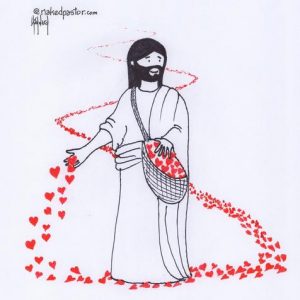
I love how things come together. Yesterday in Bible study, we discussed Mark 4–the parable of the sower (or seeds, depending on how you want to look at it). Then this morning, this cartoon landed in my Instagram feed.
This cartoon of Jesus as the sower sowing love gives me a new perspective on the parable. Art by David Hayward (@NakedPastor and nakedpastor.com).
As David writes:
The sower just throws seed everywhere. Some land here and some land there. He just throws it indiscriminately all over the field and beyond its borders and on all kinds of surfaces and in all kinds of places.
Some places are receptive. Some are not.
Some places are dangerous. Some are not.
Some are hostile. Some are not.
The lover doesn’t care.
The lover sows love everywhere.
I like this idea of sowing love much better than the typically evangelistic idea of spreading the word of God in order to “save souls” (never mentioned in the text).
Growing up around avid gardeners, I know a little bit about how seed is spread. When you garden, it’s different. You till the soil and create neat little rows. You go along behind and drop seeds or plant a seedling, gently and lovingly covering it up or patting the soil around it just so. Then you water it. Being married to a lawn care specialist gives me a different perspective. While the grasses where we live are usually sodded, grass where we used to live is broadcasted. When my husband broadcasted grass seed after preparing the lawn, seed could go pretty much anywhere. It certainly wasn’t unusual for some to land on the sidewalk or driveway, only to be swept or blown into the yard.
Whether you’re a gardener sowing seeds carefully or a lawn care specialist broadcasting seed with a spreader or by hand, you don’t quit or stop when things happen. Click here to go to Mark 4, and this is from The Message. If weeds invade the garden, the farmer doesn’t quit gardening. She doesn’t leave the food to rot, nor does she decide not to garden the following year. Same with the lawn care specialist. So what if some seeds land on the driveway where they’d never come up? He doesn’t quit because of that; he gets the seeds into the yard and goes on to the next account.
The majority of times this passage is studied and discussed, participants are challenged to think of themselves as either soil or seeds. If we’re soil then we have to choose if we’re hard and unrelenting, rocky, thorny, or good. Of course, we all want to be good soil. Or maybe we’re seeds. We’re seeds that never even take root or seeds that have a burst of life then die quickly. Or perhaps we are seeds that grow well enough but allow thorns [worries] to choke out our joy. We want to be the robust, fruitful seeds, and that’s what we hope to be.
But what about the sower? We don’t often think about him. We are called to sow the Word in this parable. Now, you might be thinking, how in the world do I get from “Word” to “love”? In John 1, we read, “the Word was God.” In I John 4, “God is love.” It’s basic math. If Word=God and God=love, then Word=love.
The sower, Jesus, sows love. Sometimes it lands on hard hearts. These hearts want this love, but just aren’t ready for it. The little persistent voice questions, “What makes you think you deserve this?” The person lets that love go because they don’t think they’re worthy.
Sometimes, the love lands on hearts that are softened and so ready. There’s that moment–and it lasts for a little while. The heart blooms under the warmth of this love, but then somehow it gets convinced that they’re not receiving the love the right way–maybe because of someone else’s religious doctrines–and it withers.
Still other times the love lands on hearts that receive it happily and gratefully. It’s thriving and growing, but then worries creep in. “Is this for real?” “How can he love me like this?” “How do I love him?” “But what about that time in college when…?” The plaguing of their minds and anxieties, doubts about their intrinsic self-worth, keeps the love from blooming to its fullest and makes it hard for the person to sow love themself.
Then the love can also fall on richly fertile, receptive hearts. This is love that takes root and grows. In the parable, Mark tells us that it yields an abundant harvest. That love blooms in our hearts, fills our souls, and pours out of us. It liberates us from all that has been holding us bondage and all that keeps us from loving God, others, and ourselves.
Then something incredible happens. We become sowers ourselves. Now it’s on us to follow the Jesus Way and sow love into the hearts of others. Sometimes the love will fall on hard hearts. Sometimes it’ll get an immediate positive reception then wither. Other times it’ll start growing in someone and their worries and anxieties will choke it out. Then still other times, it’ll land, take root, and grow, and another sower will join us. No matter where the love lands, all we’re supposed to do is broadcast that love everywhere to everyone, season after season.